SGP-003 Critics Argue Resource Fees are “Damaging to Solana”
Initial votes suggest stakeholders are strongly in favor of SGP-002 and SGP-003
Solana tokenomics proposals SGP-002 and SGP-003 are now open, with $SOL stakeholders casting their votes on two critical changes to network inflation and resource fees.
While initial votes lean heavily towards approving both proposals with flying colors, critics have become more vocal in arguing against SGP-002 and SGP-003.
Why are the experts divided on proposals theoretically designed to make $SOL more valuable?
Solana Governance Proposals Go Live
Solana’s stakeholders are once again heading to the ballot boxes to express their views on $SOL inflation and tokenomics design.
Authored by Helius’ _lostin_, SGP-002 suggests doubling $SOL’s disinflationary rate, bringing the network to its terminal inflation rate of 1.5% p.a. ~3 years early. Simultaneously, Temporal’s cavemanloverboy has floated SGP-003, which proposes introducing a resource fee designed to make Solana programs more efficient and implement a $SOL value accrual mechanic.
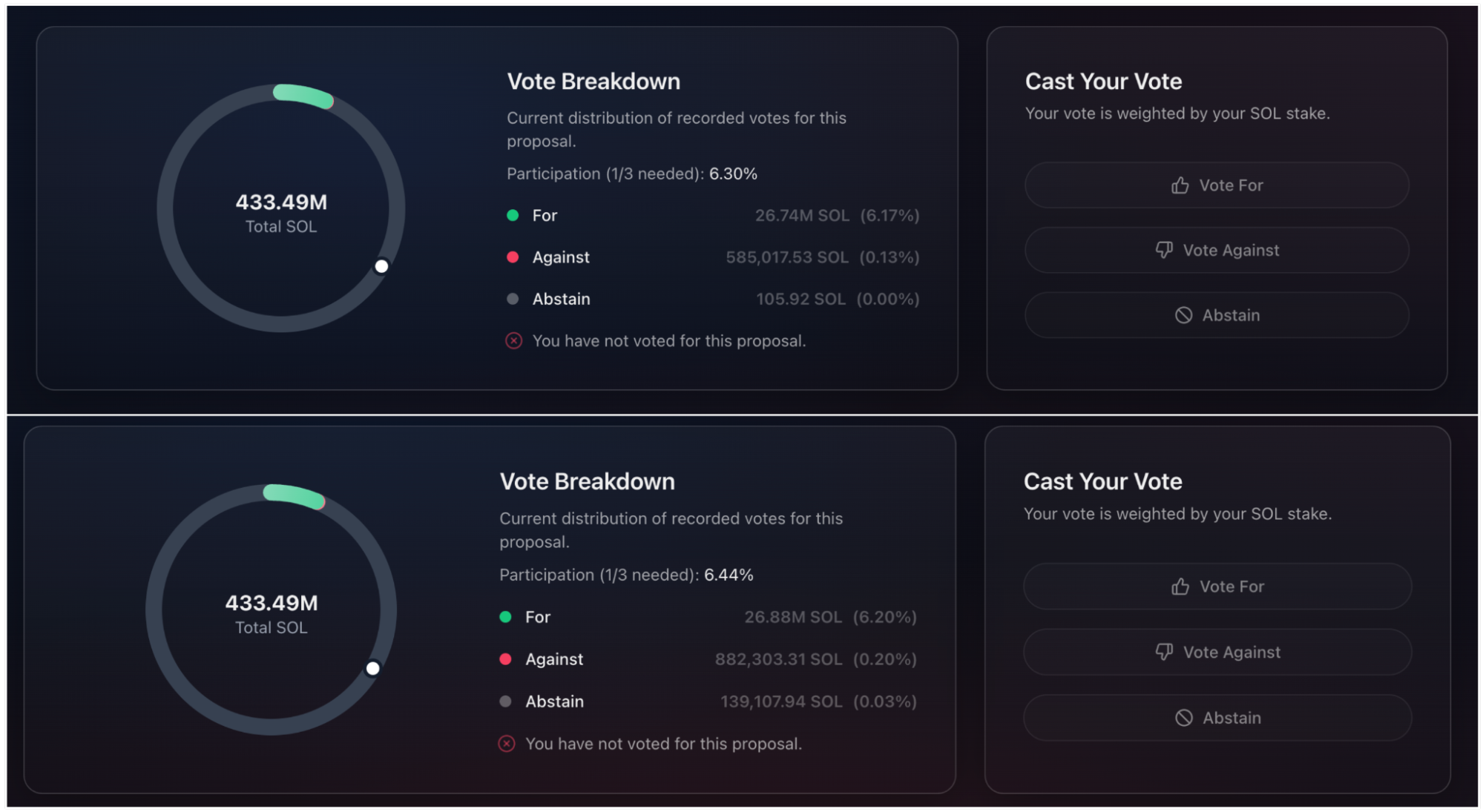
With both votes scheduled to run until the end of epoch 1024, or roughly September 28, onchain data suggests both proposals will pass in a landslide. While both SGP-002 and SGP-003 are far from reaching the 33% of stake quorum, over 96% of early voters have responded in favor of the proposals.
However, as we’ve seen previously, early voting behavior is hardly an indicator of final outcomes. SIMD-0228, an earlier governance proposal deliberately new $SOL issuance mechanics, received strong initial support, before a flurry of late voters overturned the vote, which ultimately failed.
Ellipsis Labs CEO Pushes Back on SGP-003
With SGP-003 finally being put to a vote, many of the proposal’s critics have reinforced their arguments against the suggested resource fee. Speaking out against SGP-003, Ellipsis Labs CEO Eugene Chen asserted that introducing a resource fee will make Solana a “worse home for applications”.
Chen, CEO of the firm behind Phoenix Perps and SolFi, the network’s first major prop AMM, argues that the proposal penalizes applications the author deems a “a poor use of blockspace”. By adding a fee that scales based on the complexity and resource-intensiveness, one could argue that the network discourages developers and engineers from building creative and complex applications.
Speaking with UPPU, SGP-003 author cavemanloverboy asserts that the onus is then simply on developers and engineers to write more efficient code. His sentiments were further echoed by ex-Flash Trade engineer Busy Panda, who opined that Solana needs a resource fee mechanic to ensure block space is correctly optimized.
Manifest has also expressed opposition towards SGP-003. According to Solana’s leading spot CLOB DEX, the proposal favors prop AMM architecture and could result in more onchain security risks by forcing developers to write more complex code.
Stakeholders Express Concerns Over “Lost Income”
As for SGP-002, pockets of Solana’s validator community are voicing their concerns over the impacts of doubling network disinflation. While much of the Solana community has expressed resounding support for any proposal that will lower $SOL inflation, validators argue this change comes at the direct expense of those providing the network security we all rely upon.
Triton’s Brian Long recently shared a series of arguments against SGP-002 and the proposed acceleration of Solana’s disinflation rate, citing lost stakeholder income as a potential risk to validators. Long asserts the proposal forces validators to give up income for the sake of a speculative attempt to increase price.
Helius CEO Mert Mumtaz pushed back on Long’s arguments, claiming they are mathematically incorrect and positioning it as a Trojan Horse to justify “extracting more value from users” in the name of “economic rationality”.
Ultimately, the raging debates around both proposals highlight one of the core features of blockchain governance. Everyone has self-serving interests, and these can either support or inhibit the chain’s development and progress.
Validators rightly don’t want to suffer a loss of income, and developers and engineers don’t want to pay higher fees in order to run existing programs. Neither of these positions is unreasonable, but both can be seen as counterproductive to the more popular desire among $SOL holders to try and increase the asset’s markets.
Under Solana’s new governance mechanics, stakers are now able to override validators and vote on these proposals directly. Regardless of your views, every $SOL staker owes it to themselves to learn the ins and outs of each proposal and ensure that their votes reflect their views.
Read More on UPPU
Stocks on Solana
Solana’s Tokenized Equity Market Size Hits $465M as Sunrise Brings Healthcare Stocks Onchain
SGP-003 Explained
[https://www.youtube.com/watch?v=jR_qEgWk_uM]